Intel Pentium 4 641 (Cedar Mill) - 65-nm process technology advancing

Author:
Date: 28.06.2006
|
|
Introduction
Keeping the computer "at the cutting edge of progress" is a very hard and definitely not cheap thing, especially in our rapidly developing world. No sooner had the situation with graphic adapters stabilized than new cataclysms came up, which resulted in global changes on the processor front. The announcement of new AMD AM2 platform has not indeed made serious trouble, it hasn't brought anything radical to the world, but quite little time has left before the official announcement of Intel Conroe. That is why most people are not hasty at buying a new processor - everybody is in the hiding and waiting. This calm before the storm is urged especially by regular news of the latest Conroe tests and that AMD is in for a trouble. In this situation, AMD representatives keep calm and cool and are not showing any signs of apprehension.
The outcome of this intrigue will come soon, but for now in the calm period new single-core Intel processors came in quietly to the Russian market which are supposed to be a replacement for the "oldies" based on the Prescott core. I mean the processors built on the Cedar Mill core. This core is not new - we've known it for a long time and we came across that in dual-core Intel Pentium D processors. The Cedar Mill core is half the Presler core which is produced following the 0.065-mk process technology and underlies the dual-core Intel Pentium D series 9х0 processors. In other words, I mean single-core Intel processors created following the 0.065 mk process technology.
Although Conroe is not far off already, in will arrive in Russia in no less than 2 months; besides, we are definitely in for sheer profiteering with "hot" novelties. But what if we need a new processor right now? After the drop of prices in April, Intel's dual-core processors have turned just a little bit more expensive than single-core, but for now it is hard to see the advantages of dual-core processors, and a processor like that requires a powerful PSU and good cooling. But there is another side of the coin - when overclocking Presler processors it is a rare occasion to get over the 4 GHz bar, and in so doing a very high heat emission has to be cooled. What if we remove one core out of the Presler? Of course, the frequency potentials of the processor should be much higher and the heat emission quite moderate. This is just the way the single-core Intel Pentium 4 (Cedar Mill) appears to be.
In fact, the Cedar Mill core was announced quite a long time ago, but for unknown reasons processors on its base have appeared in the Russian retail quite recently. Somehow or other, we are getting familiarized with them closer today.
The 0.065 mk process technology and a single core
We should point out the following straight off: The new core Cedar Mill does not offer improved performance as compared to the customary Prescott 2M, but on the other hand, the new "fine" process technology gives certain hopes for reduced power consumption and heat emission.
So, we have clarified that Cedar Mill is merely a half of the dual-core Presler, is produced following the 0.065 mk process technology like the Prescott 2M core, offers 2 MB of L2 cache size, and the 800 MHz system bus. Basically, all the specifications of Prescott 2M can be extended to Cedar Mill as well. As is usual, the marking has been incremented by one digit: Intel Pentium 4 630 -> Intel Pentium 4 631. It is just the "1" at the end of the name that points to the 0.065 mk Cedar Mill core. Intel have repeatedly mentioned processors whose name ends with «3» which will offer support for the Vanderpool Technology; the company even sent out specimens of these processors for tests, but currently they can't be made available either on sale or in Intel's product lists. Our search of information on this subject has brought interesting results: there have been found only 2 processors with support for the Vanderpool Technology, and their marking ends with "2" but not "3". Besides, these processors have not yet been fully sent to the retail - only a few shops offer them in their price lists, so we can't yet judge about their prices.
We suggest that you look at the table of processors whose existence and availability in the retail is authentic.
|
Processor name
|
Core
speed
|
System
bus
speed
|
Cache memory
size
|
Core
|
Average price
in Moscow *
|
|
Pentium 4,631
|
3000 MHz
|
800
|
2 MB
|
Cedar Mill
|
190 $
|
|
Pentium 4,641
|
3200 MHz
|
800
|
2 MB
|
Cedar Mill
|
220 $
|
|
Pentium 4,651
|
3400 MHz
|
800
|
2 MB
|
Cedar Mill
|
280 $
|
|
Pentium 4 661
|
3600 MHz
|
800
|
2 MB
|
Cedar Mill
|
430 $
|
|
Celeron D 352
|
3200
|
533
|
512 K
|
Cedar Mill-V
|
85** $
|
|
Celeron D 356
|
3330
|
533
|
512 K
|
Cedar Mill-V
|
90** $
|
* Prices are as per www.price.ru dated 27 June 2006.
** Prices are shown based on preliminary info.
As you can see, Intel Pentium 4 (Cedar Mill) processors are available for sale in Moscow at clock speeds up to 3.6 GHz. Pentium 4 662 and 672 offer support for the Vanderpool Technology (VT), but they haven't yet appeared on the market, especially Russian.
Haven't the latter two processors in this table attracted your attention? Who would doubt of that? These are nothing more than Intel Celeron created following the 65-nm process technology. But the most important thing which catches the eye is the doubled cache memory size - it now amounts to 512 K. No doubt, that will essentially improve their performance.
Evidently, Intel has done something to Celeron which is different from Pentium 4, and the new core Cedar Mill-V is used only in top-end processors of the Intel Celeron product line. There is also information on the third Celeron processor built on the Cedar Mill-V core which will be marked as Intel Celeron 360 and run at 3.46 GHz, but its release is planned for the middle of the summer.
Now let's explain one more most interesting point. Which chipsets support processors built on the Cedar Mill(-V) core? It is hard to answer this question clearly, so the thing is not about the chipset. It is most likely about the motherboard. To make a motherboard support Cedar Mill processors, the power scheme should conform to the VRM 10 standard. This is the standard all the boards aimed at Intel dual-core processors (chipsets i945, i955, i965, i975) conform to.
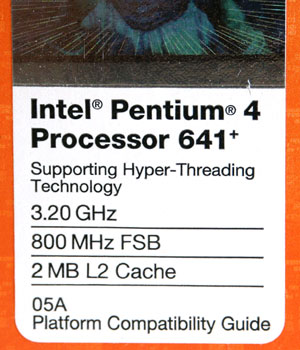
To avoid mishmash in the matters of support, Intel has introduced a special scheme of marking that points to the compatibility of platforms. It is called the «Platform Compatibility Guide» (PCG) and is designated on the processor's box and should also be shown in the specification of the motherboard.
On the processor's box, this mark can be found on the front sticker, under the hologram:
Below, under the «Platform Compatibility Guide» label there is the marking «05А» which is just the factor of platform support. In the motherboard's specification, this factor is normally shown in the "Supported processors" section. For example, here are the extracts from the Instructions on ASUS P5LD2 (i945P) motherboard:
P5LD2 specification summary
|
CPU
|
LGA 775 socket for Intel® Pentium® 4 Processor
Compatible with Intel® PCG 05B/05A and 04B/04A
and the latest Intel® Smithfield dual-core processor
Support Intel® Enhanced Memory 64Technology (EM64T)
Support Enhanced Intel SpeedStep® Technology (EIST)
Support for Intel® Hyper-Threading Technology
|
The required line is highlighted in the bold type. If this line shows only «PCG 04B/04A», then your motherboard can's support processors built on the Cedar Mill core. Unfortunately, not all manufacturers find it necessary to show the factor of platform compatibility - for example, we couldn't find this mark on Gigabyte's and Foxconn's motherboards. There is one thing we can state with confidence – all motherboards with support for Intel dual-core processors fall within the PCG 05B/05A category, so we can use that as a guideline.
We can also add that most motherboards built on the nForce 4 SLI Intel Edition chipset which also support dual-core Intel processors conform to the PCG 05B/05A compatibility factor.
If your motherboard (conforming to PCG 05B/05A) is not yet able detecting the new Cedar Mill core, simply update the BIOS with the most recent version.
Intel Pentium 4 641
We received an Intel Pentium 4 641 processor in our test lab for evaluation; this model runs at 3200 MHz (200х16) and offers 2 MB cache, so we'll be comparing it versus the younger brother Intel Pentium 4 640 based on the "good old" Prescott 2M.
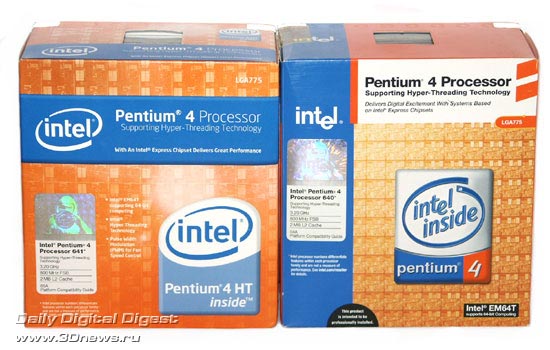
Of course, new processors are packaged into boxes with the modified «Intel» logo.
The inscription «Intel EM64T» on the box has been removed because this technology is already supported by all Intel processors, so it makes no sense reminding of that.
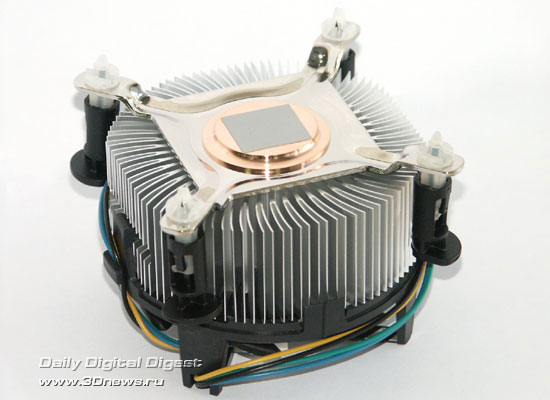
The interior of the repainted box has remained the same: the processor and its cooler are packaged in a plastic corset. The cooler has a copper core, which is definitely nice.
It seems like Intel is anyway trying to take care of the acoustic properties of its products – despite the reduced heat emission of the new processor, it is equipped with an effective cooler, which means it won't have to wound up to the full, torturing the ears of the users.
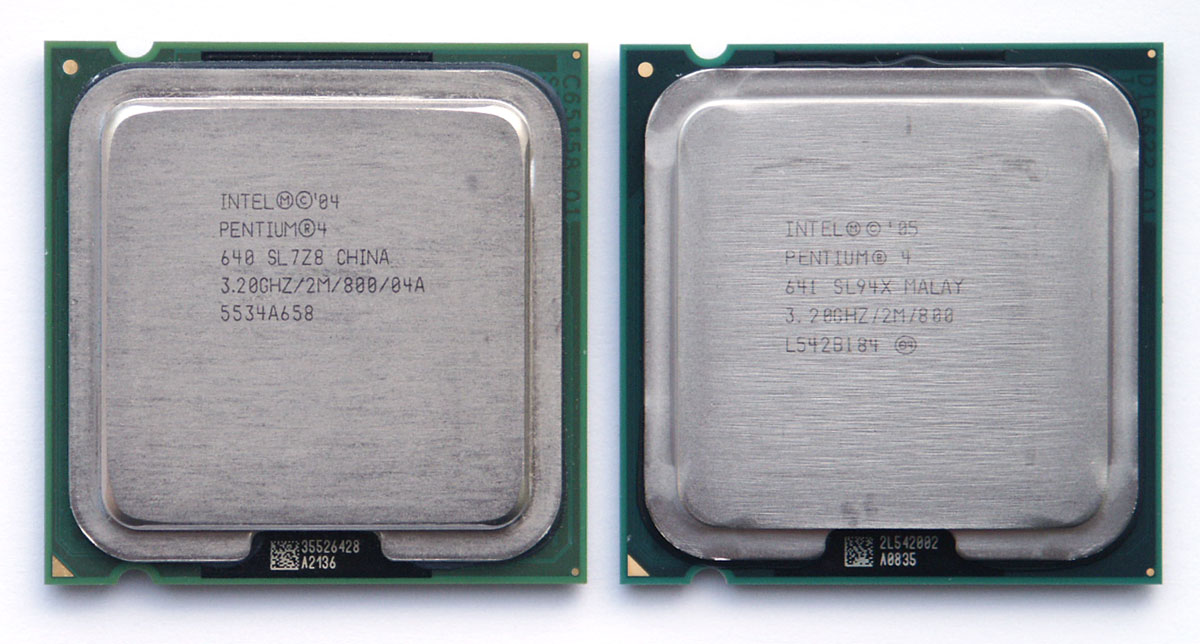
To the left – Intel Pentium 640, to the right – Intel Pentium 641
There aren't any changes on the heat-spreading lid - the differences are only in the marking, but the changes on the "belly" of the processor are seen even to the naked eye.
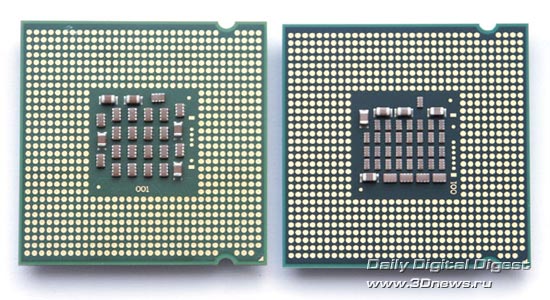
To the left – Intel Pentium 640, to the right – Intel Pentium 641
For Intel Pentium 641, a greater number of finer external components has been used. Don't mind the color of the textolyte - this difference is most likely related to the origin of processors: the Intel Pentium 640 arrived to us from China, and Intel Pentium 641 from Malaysia.
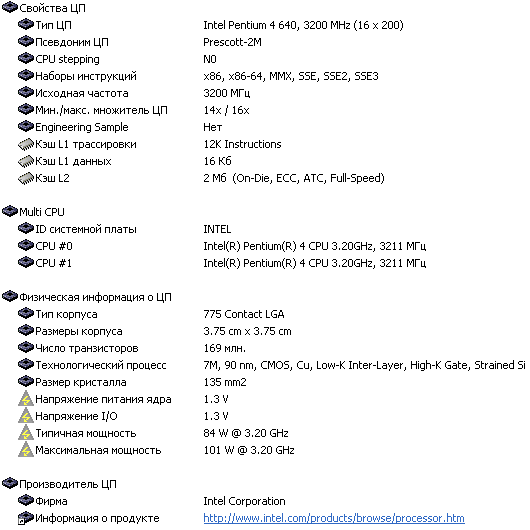
We proceeded with further examination of the processors with information utilities. This is what can be found out about the Intel Pentium 4 640 with the known utility Everest 2006:
The processor has the Prescott 2M core of revision N0, supply voltage 1.3 V and falls within the typical 84W heat package.
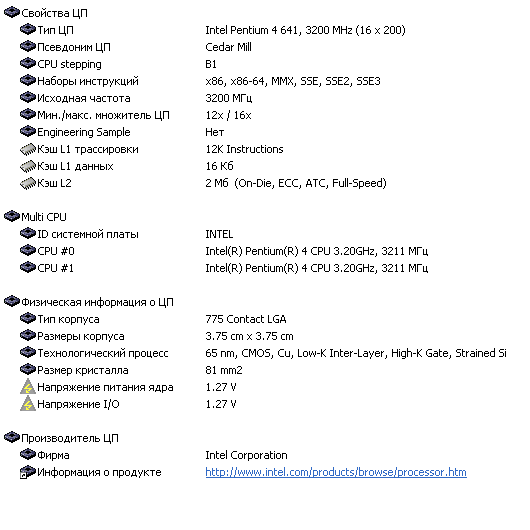
This is what the programs tells about Intel Pentium 4 641:
This is Intel Pentium 4 641 based on the Cedar Mill core of earlier revision В1 - surprisingly, its multiplier's minimum value is 12 and not 14 like in Prescott 2M, which means the processor is able reducing the clock speed to 2400 MHz in the power-saving mode.
The chip area has gone down substantially: from 135 mm2 in Prescott 2M to 81 mm2 in Cedar Mill. The supply voltage has also slightly gone down – 1.275 V versus 1.3 V in Prescott 2M. All these changes are supposed to reduce the heat emission and provide a higher clock speed.
Despite the reduced minimum multiplier, the EIST (Enhanced Intel SpeedStep Technology) wouldn't work at all like other concomitant power-saving technologies - Enhanced HALT State, and Thermal Monitor 2. This is explained by the earliest revision «В1» in which support for these technologies was not brought to perfection. The next revision «C1» has already been released and soon will be available to us. Recently, Intel has been increasingly "playing tricks" with releasing processors with "raw" revisions, but let's hope this is a temporary problem caused by the war against AMD. By the way, revision «С1» promises to bring not only support for power-saving technologies but also an improved clock speed margin.
Everest 2006 did not display information on the typical heat package, but using other utilities we were able to find out that the processor fits within the 86W heat package. At first glance, it is a bit surprising that the "colder" processor offers the TDP greater by 2 W, but it turned out that all Intel Pentium 4 (Cedar Mill) processors up to 3600 MHz (Intel Pentium 4 661) fit within this heat package.
Next
 |
Content: |
 |
|
|
Top Stories: |
|
 |
|
MoBo:
|
|
|
|
VGA Card:
|
|
|
|
CPU & Memory:
|
|
|