
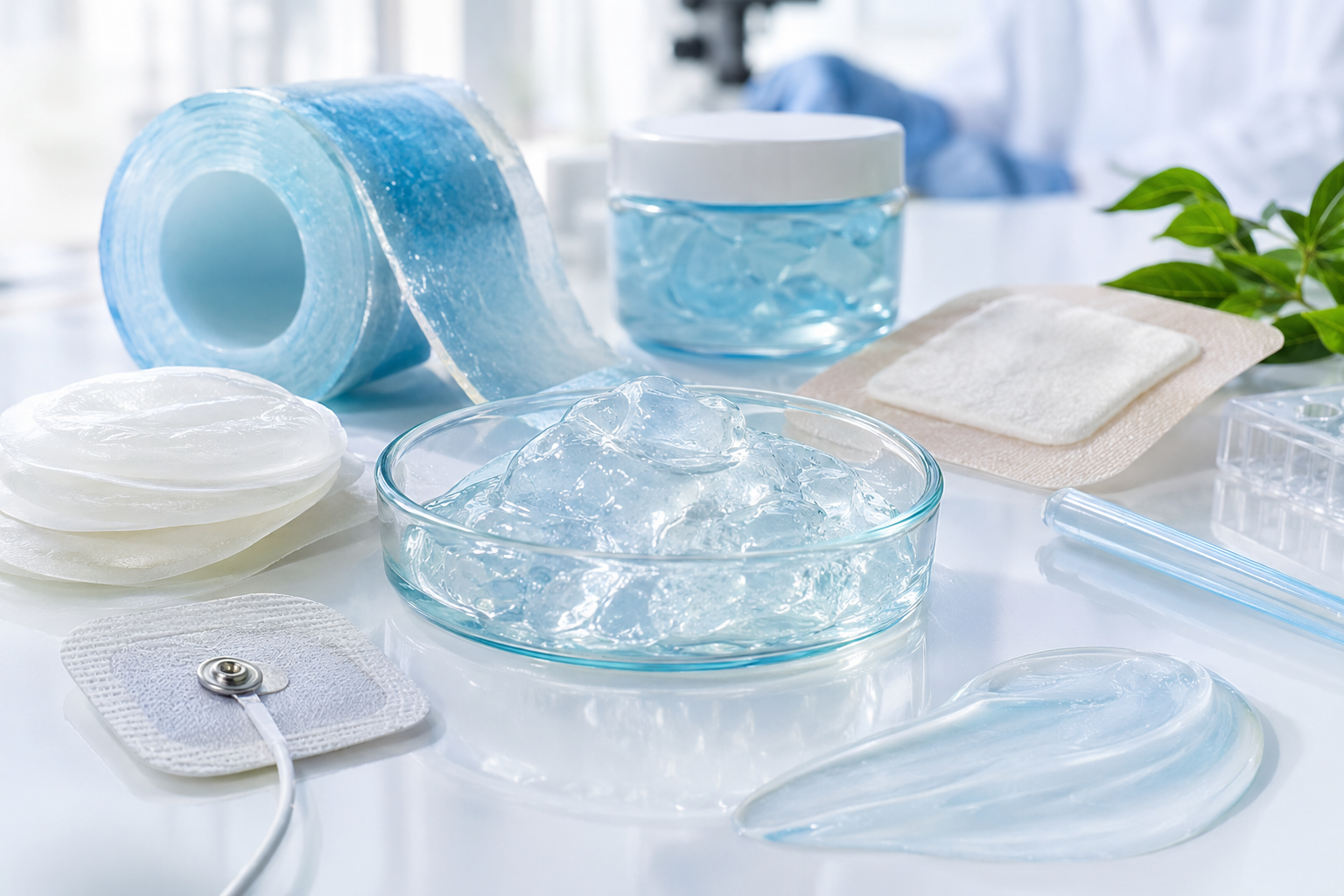
What Is a Hydrogel?
A hydrogel consists primarily of a polymer network and water. The polymer chains contain hydrophilic groups that attract water, while crosslinks connect the chains and prevent the material from simply dissolving.
The result is a structure that can hold large quantities of water while maintaining its overall form. Researchers describe hydrogels as three-dimensional crosslinked networks with substantial water absorption capacity. Their water content and mechanical properties can be adjusted through polymer selection and network structure.
Common hydrogel components include natural polymers such as alginate, gelatin, hyaluronic acid, and chitosan, as well as synthetic polymers such as polyacrylamide, polyethylene glycol, polyvinyl alcohol, and related materials.
The exact formulation depends on the intended application. A hydrogel intended for a wound dressing may require moisture retention and biocompatibility, while one intended for an electrode may need suitable electrical conductivity, adhesion, flexibility, and skin compatibility.
The Chemistry Behind Hydrogel Formation
Hydrogel chemistry is largely about creating a stable network from polymer chains. Crosslinking is the process that connects those chains.
There are two broad approaches to crosslinking: physical and chemical.
Physical crosslinking can involve hydrogen bonding, ionic interactions, crystallization, hydrophobic interactions, or other reversible forces. Because these interactions can sometimes be reversible, physically crosslinked materials may have useful self-healing, injectable, or stimuli-responsive characteristics.
Chemical crosslinking creates stronger covalent connections between polymer chains. Depending on the formulation, this can produce a hydrogel with improved structural stability and predictable mechanical properties.
Crosslinking density is especially important. Increasing the number of crosslinks generally restricts polymer-chain movement and can reduce swelling while increasing structural integrity. Reducing crosslink density can allow more chain movement and greater water uptake.
This relationship makes crosslinking one of the most important formulation variables in hydrogel development.
How Water Content Changes Hydrogel Behavior
Water is not simply an ingredient added to a hydrogel. It is an important part of the material’s behavior.
Hydrogel water can exist in different states, including water associated with polymer chains and more freely mobile water within the network. The interaction between water and polymer influences swelling, diffusion, flexibility, and the movement of dissolved substances through the material.
A high-water-content hydrogel can feel soft, flexible, and tissue-like. These characteristics are particularly useful when a material needs to conform to curved or moving surfaces.
However, high water content can also influence mechanical strength. Therefore, hydrogel development often involves balancing hydration with durability.
For example, a formulation designed for skin contact may need sufficient water to remain comfortable while also maintaining enough cohesion to stay intact during use.
Hydrogel Grades and How They Differ
The term “hydrogel grade” can refer to the intended quality, purity, formulation, or application of the material. There is no single universal grading system that applies to every hydrogel.
Research Grade
Research-grade hydrogels or hydrogel-forming polymers are commonly used for laboratory experiments, material development, and formulation research. The requirements depend on the experiment, and the material may not be appropriate for human contact or commercial medical use.
Researchers may use these materials to evaluate swelling, mechanical strength, degradation, drug release, adhesion, or other properties.
Cosmetic Grade
Cosmetic applications can require materials selected for skin feel, hydration, film formation, stability, and compatibility with cosmetic formulations.
Hydrogels can provide a soft, cooling, moisture-rich structure for products such as facial masks, gels, patches, and other topical formulations. Commercial biomedical hydrogel literature also identifies cosmetics as an important application area.
Cosmetic suitability should not automatically be interpreted as medical suitability. A material intended for a cosmetic formulation may have different specifications from one intended for use in a regulated medical device.
Medical or Medical-Device Grade
Medical applications generally require substantially more controlled specifications. Depending on the intended use, manufacturers may need to evaluate biocompatibility, sterility, chemical characterization, mechanical properties, extractables and leachables, stability, packaging, and other requirements.
The appropriate specifications depend on the final product and its intended use rather than simply the word “hydrogel.”
Organizations developing medical hydrogel products may work with specialized suppliers such as R & D Medical Products when evaluating materials, formulations, electrodes, adhesives, or other medical-device components.
Hydrogels in Wound Care
Wound care is one of the most established medical applications for hydrogels.
A hydrogel dressing can provide a moist environment at the wound surface while helping manage wound exudate. Its high water content can also provide a cooling effect, which may contribute to patient comfort.
Research reviews have examined hydrogel dressings across burns, diabetic foot ulcers, traumatic injuries, and other wound types. A systematic review and meta-analysis reported potential benefits for several wound categories, although results varied by wound type and comparison treatment.
Modern hydrogel research has also expanded toward functional dressings. Researchers are investigating hydrogels that can provide antimicrobial activity, controlled release, tissue adhesion, injectability, self-healing, or responses to environmental signals such as pH, temperature, glucose, and reactive oxygen species.
The specific formulation matters. A hydrogel designed for a superficial wound is not necessarily appropriate for every type of injury.
Hydrogels for Medical Electrodes
Another important application is the interface between an electrode and the skin.
Electrodes used for ECG, TENS, EEG, and other applications need a reliable connection between the conductive electrode and the skin. Hydrogel materials can help create this interface by conforming to skin irregularities and maintaining contact.
The water-rich structure can support ionic conduction through the interface. At the same time, adhesive properties can help the electrode remain positioned on the skin.
This is why hydrogel chemistry is important in disposable electrodes. Developers may need to balance:
- Electrical conductivity
- Skin adhesion
- Flexibility
- Moisture retention
- Skin comfort
- Peel performance
- Shelf stability
- Compatibility with electrode materials
- Ease of manufacturing
Changing one property can affect another. For example, increasing water content may improve softness but can also affect mechanical stability and long-term storage behavior.
Hydrogel Applications in Drug Delivery
Hydrogels can also act as carriers for active ingredients.
Because molecules can move through the hydrated polymer network, hydrogel formulations can be designed to release substances over time. Researchers have developed systems where release is influenced by swelling, degradation, diffusion, or environmental conditions.
Some advanced hydrogels are designed to respond to stimuli such as pH, temperature, light, glucose, or reactive oxygen species. This can potentially allow more controlled delivery in specific environments.
The choice of polymer and crosslinking system affects how quickly molecules move through the network. Consequently, hydrogel chemistry becomes an important tool for controlling release characteristics.
Hydrogels in Tissue Engineering
Tissue engineering is another area where hydrogels are widely investigated.
Their hydrated, flexible structure can resemble certain characteristics of the extracellular environment surrounding cells. This makes hydrogels useful as scaffolds and matrices for investigating cell growth, tissue regeneration, and biomaterial interactions.
Depending on their chemistry, hydrogels can be engineered to provide different levels of stiffness, degradation, porosity, and biological interaction.
Current clinical and translational research includes hydrogels for regenerative medicine, drug delivery, wound treatment, ocular applications, and other areas. A 2024 review of the clinical landscape reported more than 100 approved hydrogel products and more than 210 active clinical trials across injectable and non-injectable applications at the time of its analysis.
Why Hydrogel Formulation Matters
Two materials can both be described as hydrogels while behaving very differently.
Important formulation variables include:
Polymer type: Determines hydrophilicity, chemical compatibility, degradation, and mechanical behavior.
Crosslink density: Influences swelling, stiffness, elasticity, and stability.
Water content: Affects softness, flexibility, diffusion, and electrical behavior.
Ionic composition: Can influence conductivity, swelling, and interactions within the polymer network.
Additives: Plasticizers, conductive materials, drugs, antimicrobial agents, or other components can modify performance.
Manufacturing method: Mixing, curing, sterilization, drying, packaging, and storage can affect the final material.
This is why selecting a hydrogel is more complicated than simply choosing a material with high water absorption. The finished product must be matched to its intended use.
Testing and Quality Considerations
Hydrogel manufacturers and medical-device developers typically need to characterize the material according to its intended application.
Common evaluations can include water absorption and swelling, mechanical properties, adhesion, conductivity, pH, chemical composition, degradation, stability, and biocompatibility.
For medical products, additional testing may be required depending on how and where the hydrogel is used. Sterile products may also require validated sterilization and packaging processes.
The goal is to ensure that the hydrogel performs consistently throughout its intended shelf life and use period.
The Future of Hydrogel Technology
Hydrogel development is increasingly moving beyond simple water-retaining materials toward multifunctional platforms.
Researchers are exploring self-healing hydrogels, injectable systems, conductive hydrogels, antimicrobial formulations, responsive drug-delivery systems, and materials capable of monitoring physiological conditions.
Smart wound dressings are one example. Research is examining hydrogel systems that incorporate sensors or respond to changes in pH, temperature, glucose, pressure, or other wound characteristics.
These developments demonstrate why understanding the underlying chemistry remains important. The same basic concept of a hydrated polymer network can be modified to produce very different performance characteristics.
Conclusion
A hydrogel is fundamentally a crosslinked, water-rich polymer network, but its performance depends on much more than its water content. Polymer selection, crosslinking chemistry, network density, additives, manufacturing methods, and intended application all influence the final material.
From wound dressings and drug delivery to medical electrodes, contact lenses, tissue engineering, and cosmetics, hydrogels offer a flexible platform for designing materials that interact closely with water and biological surfaces.
For companies developing medical products, understanding these differences is essential when selecting materials and defining performance specifications. Suppliers and developers, including R & D Medical Products, can use these principles when evaluating hydrogel-based components for particular applications.
Frequently Asked Questions
What is a hydrogel?
A hydrogel is a three-dimensional network of hydrophilic polymers that is crosslinked so it can absorb and retain significant amounts of water without dissolving.
What does crosslinking do in a hydrogel?
Crosslinking connects polymer chains and creates the network structure. The degree and type of crosslinking can influence swelling, strength, elasticity, degradation, and overall stability.
Why does hydrogel water content matter?
Water content affects softness, flexibility, swelling, diffusion, conductivity, and how the material interacts with biological surfaces. Different applications therefore require different hydration characteristics.
Are all hydrogels suitable for medical applications?
No. A hydrogel suitable for research or cosmetics is not automatically suitable for a medical device. Medical applications can require specific chemical, physical, biocompatibility, stability, sterility, and regulatory specifications.
How are hydrogels used in wound care?
Hydrogel dressings can maintain a moist wound environment, manage some wound exudate, provide cooling, and serve as carriers for active ingredients. Evidence varies according to the type of wound and hydrogel formulation.
Why are hydrogels used with medical electrodes?
Hydrogels can create a hydrated interface between the electrode and skin, supporting electrical contact while also providing flexibility and, in some formulations, adhesion.
Can hydrogels be used in cosmetics?
Yes. Hydrogel materials are used in cosmetic applications where hydration, cooling, flexibility, film formation, or skin feel are desired.
What factors should be considered when selecting a hydrogel?
Important considerations include polymer chemistry, crosslinking method, water content, mechanical strength, adhesion, conductivity, biocompatibility, degradation, stability, sterilization requirements, and the intended end use.